Showing posts with label readings. Show all posts

Tuesday, April 5, 2016

The One-in-a-Million Monica Wood


Not to sound like too much of a fan girl, but I love Monica Wood. 

Her work is tender and evocative. She gives the best readings. And by all appearances, she's just a decent human being. 

Basically, I want to be Monica Wood when I grow up.

A few weeks ago, I saw that Ms. Wood had a new novel coming out and on a whim I asked her for a quick interview. To my delight, she agreed. Below, you'll find our conversation and a promo video of Monica describing her new book, THE ONE-IN-A-MILLION BOY.


What does your typical writing day look like?


Years ago, every day looked about the same, but my professional life is far more complicated now. I spend a ridiculous amount of time on email, for example, managing the business of a full time professional writer. I usually have a stack of manuscripts that people have asked me to read. So my writing time is ever more precious, and I guard it jealousy. I am naturally a night owl but because I married an early bird my writing time is midday, about 10 until 3. Given my druthers, I would write all night and sleep till noon.

One thing I should mention if any young writers are reading this. I turn off all devices while writing. I don't have internet access on my laptop, which is where I write. Instead, I have a separate computer to connect to the wider world.


I had the good fortune of attending one of your events and it was the most entertaining reading I’ve ever seen. You have a terrific way of engaging the audience. You read just enough to whet the audience’s appetite and then weave in anecdotes and stories from your own life. What are your secrets for giving a great reading?


Experience helps. You learn over time to select not your best stuff, necessarily, but the best stuff to read aloud. Look for a lot of white space on the page; that's a good rule of thumb. Also feel free to heavily edit. The audience doesn't need a lot of context. I have also learned over time an audience would rather have you speak about the book then read at length. I usually read for about 20 minutes in 10 minute segments, between which I talk about different aspects of the book itself or the writing of it.


Last year your first play “Papermaker” was brought to life by the Portland Stage Company an drew wide acclaim. How did it compare to the world of novel writing?


There is simply no comparison between writing a novel and writing a play. 

With a play you need constant input from readers, actors, and a good director. I was crazy lucky to have all of the above. With the play I had all kinds of people rowing the boat with me. What a difference from typing alone in a room. For years. With no input from anyone. Alone. Did I already say alone?


It must be magical to see actors embody your characters.

It is indeed magical, but it requires a huge willingness to let go. Actors are interpreting your words and you have to give them room to surprise you. Some of my favorite moments in PAPERMAKER were quite different from my original intention. Also, every performance is different. I both dread and look forward to seeing the play with another cast.


In your new novel, THE ONE-IN-A-MILLION BOY, you do something rather unusual--you kill off the title character on page two (I don't think I'm spoiling anything here!), yet his character continues to influence the story throughout. Was this your original intention, or did the idea evolve during the writing process?

Most things happen as I am writing, but this wasn't one of them. The challenge for me was to keep the boy alive for the reader throughout the book and I think I accomplished that. The boy appears so often - through lists he composed, recordings he made with his elderly friend, and flashback scenes -- that many readers forget he's dead. This challenge led to some structural quirks that I like.


Another unusual choice is that you never reveal the boy's name--why? 

Every time I started to name him it felt wrong. To name him was to pin him to the earth, but he no longer is of the earth. he does actually have a name but only I, my husband, and my oldest sister know what it is. She named him. 


The cover is gorgeous. Did you have a hand in choosing the design, or was it a complete surprise to you?

Oh, boy, is this ever a long story! I hated this cover with a red hot passion but everyone from sales and marketing adored it. I thought it was too whimsical for the content , and I despised the literal depiction of a boy on a bicycle. My US publisher agreed to alter the cover. But then my UK publisher went nuts over the American cover, their sales and marketing people went nuts, and so I finally caved. And they were dead right, of course: most of the countries publishing this book are using the original cover. Lesson: writers should stick to writing and leave selling to the sellers.


It can be a fine line knowing when to stick to your guns and when to defer to the 'experts'. When it comes to editing, how do you react to those occasional suggestions that seem to come out of left field? 

I have worked with a lot of editors over the years, and very very seldom have I had to put my foot down. I can honestly say that an editor has never given me terrible advice. This is not to say I have never had disputes, but I have always found that the best way to handle differences with an editor is to take a deep breath, step back, and try to see the manuscript afresh. They are frequently right. At the same time, we must not forget that as writers we have the right to say no. Lots of new writers are afraid to say no because they fear alienating the editor. But editors expect give and take. They thrive on it! The world will not end if you speak your mind. 


THE ONE-IN-A-MILLION BOY (Houghton Mifflin Harcourt) by Monica Wood is available in bookstores, now. Click here to access Ms. Wood's tour schedule. 


Monday, March 30, 2015

Being Part of the Writing Community


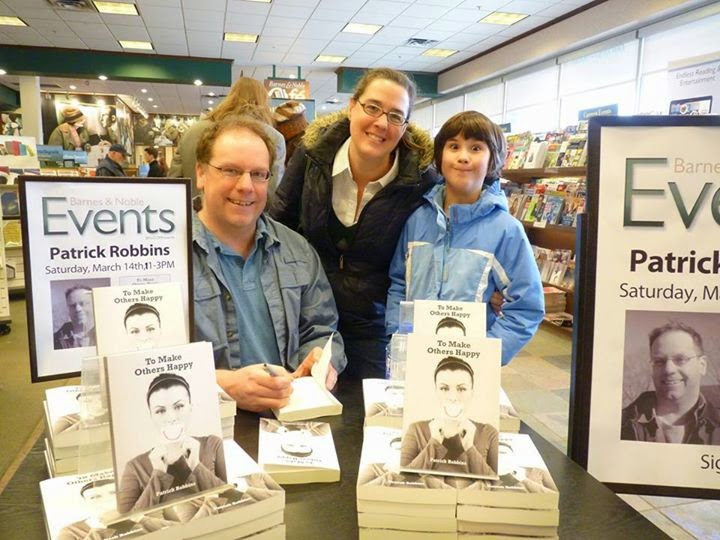
Over the past week, I had the pleasure of attending two book signings for first-time novelists. The first was for my longtime friend Patrick Robbins, who just published his novel TO MAKE OTHERS HAPPY (Three Wide Press). It was heart-warming to see Pat surrounded by copies of his book, as well as the crowd of friends and family who came out to support him. A friend stood by with a camera to snap pictures for a memory book (including the one below). It reminded me a little bit of a graduation party--one of those precious few days in a person's life when you are showered with so much love and support and admiration and pride. It can be overwhelming and humbling in the best possible way. Pat's busy with promotional duties at the moment, but soon I'll have a follow-up interview with him to fill you in on all the details about his road to publication.

Patrick, me, and my daughter, Kate.  (photo credit: Emily Richards)


The second event I attended was a literary introduction series co-sponsored by The Author's Guild and Richard Russo, who currently serves as one of the guild's vice presidents. Russo has long been a champion of young writers (myself included) and understands how difficult the publishing landscape is right now for unknown authors of what he describes as "hard-won novels" or literary fiction. To help these writers get discovered, Russo has launched a reading series where established writers interview up-and-comers whose work has caught their attention. There will be a few of these readings in Portland, Maine and in New York City, with the hope that they will eventually roll out across the country.


The featured author of the night was Eddie Joyce, author of SMALL MERCIES (Viking), a story about a Staten Island family devastated in the wake of 9/11. While I was waiting for the even to start, a woman sitting in the row in front of me turned around and noticed I was reading the book flap. She touched my arm and said, "It's a wonderful book, you know. My son wrote it." We both started to laugh and I offered my congratulations. As it turned out, Richard Russo happened to be her favorite author. Joyce and Russo share a publisher, so the young author's editor suggested they send Russo a galley in hopes that he might blurb the book. The fact that Russo had chosen her son's novel to feature among the enormous pile of requests he regularly receives was a stunning turn. Other members of Joyce's family were in attendance and once again, like my friend Pat's signing, the room was filled with the most wonderful spirit of excitement, joy, and awe.

One of the goals of this literary series is to not only to help new authors break out, but to establish a sense of community among writers. When it came time for the question-and-answer portion of the program, a man stood up and acknowledged that it was a difficult time for writers and asked what we, the public, could do to support them. It was such a brilliant question--so many questions in this type of forum are limited to the "inward" pursuit of writing, such as inspiration and process. How often do we, as writers, look outside ourselves and to the larger community of writers to see how we contribute to the culture as a whole?

Both Russo and Joyce stressed the importance of shopping at your local independent bookstore. We all know the economic arguments for shopping locally, but the added advantage to both writers and readers is that local bookstore owners read widely and can make recommendations. By developing a relationship with your local booksellers, they can learn your tastes and suggest new writers you might like.

So often it feels like we writers are at the mercy of a difficult industry, but the events of this past week made me feel empowered. If we--members of the writing and publishing community--decide to come together and support one another by attending readings, purchasing books locally, and taking a chance on lesser-known writers, then just maybe we'll begin to turn the tide in our favor.

In what ways do you support your writing community? Please share your thoughts. 

Wednesday, March 18, 2015

10 Questions to Answer Before You Give an Author Interview


When I was getting ready to go on my first book tour oh-so-many years ago, I spent a lot of time preparing for interviews and appearances. I had banners and posters made up for book fairs, created a tour schedule, purchased tasteful clothes and good pens for signings, sent out press releases and mailings, carefully selected and edited excerpts for readings and spent hours practicing reading aloud. In short, I felt I had done everything I could to get ready for the tour.

Unfortunately, I failed to do the most important thing of all--which was to understand my book.

I had thought that working on a manuscript intensely for five years made me an expert on the work. Hardly. It wasn't until I had a live interview for a writing website that I realized how underprepared I was for discussing it. The interviewer typed the very simple question--"What is your book about?" and I completely froze. I stared at the blinking cursor for five long minutes, prompting the interviewer to ask if I was all right.

It's not that I didn't know what my book was about, exactly. It was a novel that spanned forty years and followed two boys into adulthood. A whole lot happened in between, but nothing I felt I could pin down in two sentences. Or at least two interesting sentences. Much of what is appealing about literary fiction lies in the telling more than that concept. Or at least that's what I told myself. As I discovered too late, you still need to have a pitch.

Over the course of the next month or so, as the reviews started rolling in, I started getting a little perspective on what the story was about. Through other people's eyes I began to see themes and connections that I didn't realize were there. I know it sounds strange to be so removed from the story, but sometimes you can be too close to a project to see it properly.

I decided that in order to feel more comfortable discussing my book I needed to approach the story like a reader. I thought about some of the questions I was asked during my first interview and began writing down the answers. Basically, I wrote a report on my own book. I also came up with a list of commonly asked questions that I had often heard asked at readings and answered those, too. Even a question as simple as, "What is your favorite book?" can be difficult to recall in front of an audience. By taking a little time to think about my answers beforehand, I felt much more confident with each subsequent appearance. By the end of my book tour I had my pitch down and I was a bit more relaxed when answering questions.

Here are ten commonly asked questions I try to think about before I do an interview or reading:

1. What is your book about?

2. How long did it take you to write it?

3. Where did you get the idea for the book?

4. What is your writing process? How often do you write?

5. Who/what are some of your favorite writers/books?

6. How did you get published?

7. When did you know you wanted to be a writer?

8. What are your thoughts on self-publishing/print-on-demand?

9. What advice would you give an aspiring author?

10. What are you working on now?  


Share your experiences. How do you prepare for author interviews?


Tuesday, November 12, 2013

Performance Skills

Recently, had the honor of being one of the judges in a writing competition hosted by my local library. At the awards ceremony this weekend, each of the winners read their work aloud. It was an interesting mix of performances--some of the writers (more than I would have expected) obviously had lots of public speaking experience and were comfortable reading before a crowd, while others looked a little bit nervous and out of their element. Unfortunately, the winner of the category I was judging--fiction--was away at a writers' conference and so I didn't have the opportunity to meet him. His story was read by my friend Emma, a librarian and organizer of the event.

While I'd really enjoyed the winner's story on the page (obviously), Emma's reading was stellar. As she read the piece she was bringing the story alive, elevating it. It wasn't just that the words were being read aloud, they were being read well. Emma was hitting the comedic beats with such impeccable timing that she was taking a sweet, humorous story and making it hilarious. The audience went wild for it.

After trying to figure out how I could hire Emma to do all my future readings, I began to wonder how some of the other pieces we'd heard that afternoon would have come across if she had been the reader. Conversely, I wondered how some of the pieces that were presented by confident readers would have sounded in less capable hands. This really drove the point home for me that author readings were less about the writing and more about the performance.

One of the best readings I've been to in recent years was by Monica Wood, author of WE WERE THE KENNEDYS. While many readings follow a simple format of introduction/10-15 minutes of reading/Q and A, Monica talked about how the book came to be, techniques in memoir writing, and her recent trip to Ireland. She even sang a duet with her husband! She interspersed these anecdotes with five-minute bursts of reading. Truth be told, I don't think she read much at all--just enough to whet the audience's appetite for the book.

The thought of having to perform for an audience probably strikes terror in the heart of most writers--I know it does mine. We are, by nature, a more introverted breed, better suited to sitting alone at our desks than getting up in front of a room full of people. But publicity is part of the job, and with some practice, it can actually be fun.  I took a reading seminar with author, playwright, and actor, Howard Waxman, and here are some of the things I learned:

1) THE AUDIENCE IS ON YOUR SIDE. It's in their best interest to root for you. Think about it--if you do well, they'll be entertained. If you're shaking and mumbling, they'll be squirming in their seats, feeling your pain.

2) YOU DON'T HAVE TO BE SHAKESPEARE. Don't apologize for not being the greatest writer who ever lived. There will always be someone better than you and someone worse. It's not a contest. Simply say to yourself that this is the best work you are capable of at this moment and be proud.

3) BE SELECTIVE. Pick a scene that will sound good out loud. Dialogue, action, and humor all play well to an audience. Long narrative description will put them to sleep. Don't be afraid to edit your scene for brevity, clarity, and time constraints. Don't forget to explain anything in the scene that the audience won't understand out of context.

4) PRACTICE! PRACTICE! PRACTICE! Time yourself. Slow down, then go half that speed. E-NUN-CI-ATE. Exaggerate. Animate. Give each character a different voice. What feels over-the-top to you will most likely just barely register with the audience. A good exercise is to practice reading children's books aloud as if you are reading to a group of preschoolers (or, better yet, find a real group of preschoolers to read to!). Taking an acting class is also helpful.

5) HAVE A FEW ANSWERS READY.  Instill confidence in yourself during the Q and A period by having the answers to the most frequently asked questions ready. At every reading I've ever been to, someone has asked about writing habits, the creative process, favorite books, etc. Know your answer beforehand. Also have a few comments ready in case no one in the audience is brave enough to ask questions.

6) ENJOY THE EXPERIENCE. Think about how lucky you are to have the opportunity to share your work. As nerve-wracking as public speaking is, it's a nice contrast from the lonely work we have to do from day to day. You may even find, with enough experience, that you'll love it.