Showing posts with label signings. Show all posts

Friday, April 17, 2015

Living the Dream: Patrick Robbins Part III


[Update: I've now included a link to the video of Pat's Reading here.]
As some of you might recall, I did a few blog posts back in 2008 following my friend Patrick Robbins as he cloistered himself in an Airstream trailer to write his first novel. While the manuscript came together very quickly, it took six years before the book was published. Read my follow-up interview to find out how Charles Schulz, Greg Brady, and an old friend eventually helped to make Pat's dream come true.   


How does it feel to be a published author?

Oy! (To coin a phrase.) This is something I've wanted for years, decades even, and now that it's here... it's just as good as I always imagined it. Picture a combination of the satisfaction in a long-term job well done and the delirium of an oil well finally coming in. I would compare the whole thing to a sports team winning a championship - on the one hand, "Mission accomplished, gentlemen." On the other hand, "WE WON!!! WE WON!!!"

I mentioned in a previous post that your first book signing felt a little like a graduation party--it's one of those few events in life when you are surrounded by so much love and support from your friends and family. How do you remember that day?

Photo by Alina Pauksis
Sheer unadulterated joy. It was so much fun seeing people from throughout my past - grade school, high school, college, various jobs - mingling with my family, all of them in couldn't-be-happier mode. The event was originally just going to be a signing, but people were clamoring for a reading as well; major, major kudos to Stacy Shea, the Barnes & Noble community relations manager, who whipped up 30 chairs in nothing flat. I hadn't read aloud from my work in years, but I wasn't nervous in the slightest - who can be nervous about having their dream come true? The whole thing went great; people wanted to buy it after hearing it, and one of my coworkers was so overcome she couldn't speak, which was something to see. One friend took pictures and video of the whole event, so I've got a permanent scrapbook. And my dad said he never knew I could carry a tune (part of my reading included the singing of "Amazing Grace"). The expected snowstorm didn't even show up. It was just a perfect day.

Your road to publication was a little bit unusual. Tell us how it came about.

I started sending letters of inquiry to agencies and got between forty and fifty rejections. After a while, you start to believe these people really know what they're talking about. One [agent] said it was clear I had real talent, but my book didn't seize the reader by the throat within the first five pages and that's what was selling these days.

Looking for another way to skin a cat, I got in touch with a friend of mine who's a branding strategist. At the time, he maintained the Facebook page of Barry Williams, a.k.a. Greg Brady on The Brady Bunch; he said he'd have Barry talk about my manuscript  [on Facebook] and ask for help getting it out there. Ninety-eight percent of the responses were "Get it self-published!" or "Can't help, but it sounds great!" But one man said, "I think I can help your friend" and left his contact info. I called, we talked for a few hours, and he said to send the manuscript to his agency, with his recommendation. "But don't you want to read it first?" I asked. He said that it was his experience that when you do good, good comes back to you. I'll never forget him for that act of kindness to a guy he'd never met.

I sent in the manuscript and, mirabile dictu, they were interested and wanted to represent it. I took it through three more drafts per their request. After the third one, they wrote to say that it still hadn't come together the way they wanted, and they were going to step away from it. That was pretty devastating - so close and yet so far. On the other hand, it was three drafts better than it had been.

At this point, enter Thom Hayes. He was my boss [when I worked at] Barnes & Noble. He read a draft or two of the book and told me not to give up on it. But I had. When the world reaches a consensus, it's very, very hard to go against the world. I chalked it up to bad luck, consoled myself with the fact that I'd actually written a novel, and got on with my life.

Then, maybe a year and a half ago, Thom  said he was going to be starting a publishing company, 3 Wide Press, that was going to focus on sports titles. He asked if I'd let him publish my book once he got the company going, even if it was outside the company's mission statement. Hey, sure, I said, it's good to plan ahead. Then I promptly forgot about it.

Last December, Thom wrote and said, "Are you still cool with me publishing TMOH?"  By the end of February, I was holding my book in my hands. One with a bar code and everything. The whole trip took six and a half years; if it had taken half that long, the book would not have been as good as it became. My dad, who taught high school English for over 30 years and still reads two or three books a week, told me after he'd read his copy, "The first draft was the work of an adolescent; this is the work of an adult." I grew up with To Make Others Happy, and it introduced me to a lot of true heroes. I'm truly grateful that the road to publication was as long and winding as it turned out to be.

Publicity and marketing for a first-time author can be a real eye-opener. What has surprised you the most?

The biggest surprise was that I didn't get responses to emails that I sent stores. I crafted a hell of a cover letter, emphasizing my/my book's connection to the various towns these stores were in, and got no responses. I would've guessed that emails were how many of their author contacts were born, but apparently not. So I've switched to actually driving out to the stores, letting them hold the book, making eye contact as I make my pitch. It's worked a lot better. It's also nice to see their faces light up when I tell them the book has a national distributor.

Have you used social media to get the word out?

I've created a Facebook page and have taken initial steps on my author page for both Goodreads and Amazon. I'm also a regular contributor to two blogs - I'm features editor for Cover Me, a blog about cover songs, and I'm "Grandpop Culture" on Acts of Geek - and I spread the word there. I don't Tweet, but frankly, some might consider that a blessing.

You've said that TO MAKE OTHERS HAPPY is inspired by Charles Schulz. What's the connection?

A series of Peanuts comic strips from 1961. Lucy asks Charlie Brown why he thinks we're put here on Earth, and he immediately responds, "To make others happy." Instead of saying "You blockhead!", as is her wont, Lucy dwells on this response over the course of three strips. [TMOH] is divided into three parts, and each part begins with the dialogue from those strips (thanks so much to the Schulz estate for granting permission). An even closer look will reveal that each part of TMOH is a sort of mirror to the Peanuts dialogue - but where I take a hundred pages to tell that segment of the story, Schulz only needed four panels. He was a genius. He had punchlines like "There's no heavier burden than a great potential" and "This world is filled with people who are anxious to function in an advisory capacity."

In many ways, the relationships at the center of the story reminded me of THE GREAT GATSBY. 

Very much so - of all the Books You Have To Read In High School, it's probably my favorite. I like books where the first person narrator isn't the center of his own story (One Flew Over the Cuckoo's Nest is another good example of that); you're as close to the hero as you can be without being in his head, and as the hero affects the narrator, so he affects us. Also, in TMOH, Ned and Nadine are second cousins, while in Gatsby, Nick and Daisy are second cousins once removed. And Tedd Long, Nadine's unpleasant partner, is a sort of Tom Buchanan. I didn't set out to write a Gatsby Jr., but as I wrote, I recognized that there were distinct echoes; I figured the best thing to do would be to not look at Gatsby at all during the writing and rewriting, for fear of being too influenced. But I couldn't resist one good tip of the cap; Nadine, talking about a restaurant says, "The place is full of money," which is a mini-tribute to Gatsby saying of Daisy, "Her voice is full of money."

At my last writing group meeting, we all lamented the fact that what we write is often so vastly different from what we love to read. For example, a friend of mine loves literary fiction with a gothic or fantasy element but is finding that her latest work is a straight-up genre piece. Do you find this disparity in your own work? 

To be honest, no, I don't. My work is grounded in old-school storytelling, in no small part because that's the kind of stuff I like to read the most. I'm talking William Goldman, Elmore Leonard, Richard Stark, Stephen King, the short stories of Irwin Shaw, that kind of thing. But I also love the lyrical flourishes of Fitzgerald, Amy Hempel, Kyril Bonfiglioli, Mark Kram, and more. So if the writer is keeping the story moving, but also taking the time to have fun with the language, the field they're writing in doesn't matter so much to me. I see the genre as the clothing and the storytelling style and craft as the body. Keep the body in shape and you can dress it any way you want.

I met you when we were both undergrads at Colby, where we both studied with Jennifer Boylan and Richard Russo. You later went on to get your MFA from the University of Massachusetts-Amherst. What are your thoughts on the MFA/no MFA debate among writers?

I'm pro-MFA. Quick story: I was in a tavern with several others from the program, and there was a lot of griping going around about office politics, who taught which classes in which rooms, etc. Someone said I must be mad with the program, as I was unable to land a teaching gig and was therefore paying off the whole thing with student loans (I'm currently $49K in the red). I said that I couldn't be mad because I was becoming a better writer, which was exactly why I went there, so anything going on around me that didn't interfere with that was just white noise to me. Kind of brought the discussion to a grinding halt.

Where it helped me the most was with rewriting. Grad school was where I finally learned how satisfying it was to rip out the middle of a story, to arrange a sentence so the most important part came as close to the period as possible, to always look for better verbs, to seek and destroy the passive voice.

If you learned everything you needed to know about writing from a quality undergrad program and from extensive reading and writing, God bless you. Nothing wrong with that at all. Me, I needed that extra fine tuning, and in my MFA program, I got it.

Are you working on anything right now?

I've got two ideas I like - wunza road trip / treasure hunt, wunza story of an actor turned cop. I'm further along on the first idea - I've got the whole thing plotted out on index cards and have written about twenty pages - but I'm taking down good plot points and quotes for the second idea as they come to me. Now that I've quit my job of five and a half years, I'll get to make some real progress on both of them. That's the plan, anyway - if things progress like they did with the first book, we may not see them until 2021 or so. Well, something to look forward to!

Patrick is scheduled to read from and sign copies of To Make Others Happy at Buffalo Street Books in Ithaca, NY, on May 9 at 3pm, and at the Odyssey Bookshop in South Hadley, MA, on May 19 at 7pm. Good seats still available.

Monday, March 30, 2015

Being Part of the Writing Community


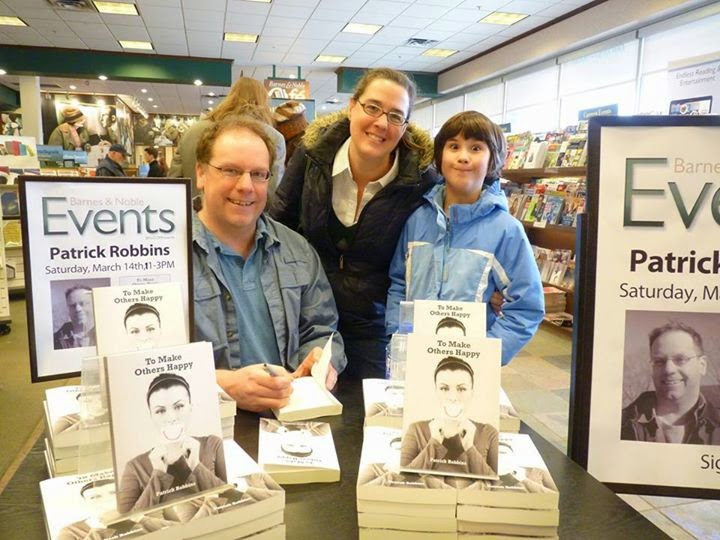
Over the past week, I had the pleasure of attending two book signings for first-time novelists. The first was for my longtime friend Patrick Robbins, who just published his novel TO MAKE OTHERS HAPPY (Three Wide Press). It was heart-warming to see Pat surrounded by copies of his book, as well as the crowd of friends and family who came out to support him. A friend stood by with a camera to snap pictures for a memory book (including the one below). It reminded me a little bit of a graduation party--one of those precious few days in a person's life when you are showered with so much love and support and admiration and pride. It can be overwhelming and humbling in the best possible way. Pat's busy with promotional duties at the moment, but soon I'll have a follow-up interview with him to fill you in on all the details about his road to publication.

Patrick, me, and my daughter, Kate.  (photo credit: Emily Richards)


The second event I attended was a literary introduction series co-sponsored by The Author's Guild and Richard Russo, who currently serves as one of the guild's vice presidents. Russo has long been a champion of young writers (myself included) and understands how difficult the publishing landscape is right now for unknown authors of what he describes as "hard-won novels" or literary fiction. To help these writers get discovered, Russo has launched a reading series where established writers interview up-and-comers whose work has caught their attention. There will be a few of these readings in Portland, Maine and in New York City, with the hope that they will eventually roll out across the country.


The featured author of the night was Eddie Joyce, author of SMALL MERCIES (Viking), a story about a Staten Island family devastated in the wake of 9/11. While I was waiting for the even to start, a woman sitting in the row in front of me turned around and noticed I was reading the book flap. She touched my arm and said, "It's a wonderful book, you know. My son wrote it." We both started to laugh and I offered my congratulations. As it turned out, Richard Russo happened to be her favorite author. Joyce and Russo share a publisher, so the young author's editor suggested they send Russo a galley in hopes that he might blurb the book. The fact that Russo had chosen her son's novel to feature among the enormous pile of requests he regularly receives was a stunning turn. Other members of Joyce's family were in attendance and once again, like my friend Pat's signing, the room was filled with the most wonderful spirit of excitement, joy, and awe.

One of the goals of this literary series is to not only to help new authors break out, but to establish a sense of community among writers. When it came time for the question-and-answer portion of the program, a man stood up and acknowledged that it was a difficult time for writers and asked what we, the public, could do to support them. It was such a brilliant question--so many questions in this type of forum are limited to the "inward" pursuit of writing, such as inspiration and process. How often do we, as writers, look outside ourselves and to the larger community of writers to see how we contribute to the culture as a whole?

Both Russo and Joyce stressed the importance of shopping at your local independent bookstore. We all know the economic arguments for shopping locally, but the added advantage to both writers and readers is that local bookstore owners read widely and can make recommendations. By developing a relationship with your local booksellers, they can learn your tastes and suggest new writers you might like.

So often it feels like we writers are at the mercy of a difficult industry, but the events of this past week made me feel empowered. If we--members of the writing and publishing community--decide to come together and support one another by attending readings, purchasing books locally, and taking a chance on lesser-known writers, then just maybe we'll begin to turn the tide in our favor.

In what ways do you support your writing community? Please share your thoughts. 

Wednesday, March 11, 2015

Care About the Work, Not the Result


One of the best books I've read recently is comedienne Amy Poehler's Yes, Please. Part memoir, part advice book, it's chock-full of wisdom for anyone in a creative field. One of my favorite lines in the book is: CARE ABOUT THE WORK, NOT THE RESULT.

Creativity, Poehler says, is where we find our joy and comfort. We need to put our effort into making the highest quality art that we can. This is THE WORK. It's what sustains us, nurtures our soul. It's what we'd want to do even if we weren't getting paid for it. The work is what is in our control.

THE RESULT is something else entirely. It is how our work is received. The result is agents and publishers and bestseller lists and awards. It's our career--and much of it is outside our control. Poehler describes career as "a bad boyfriend" who "ignores you and doesn't call, who flirts with other people right in front of you. With a bad boyfriend, you're never satisfied." You'll always want more.
The best way to handle a career, like a bad boyfriend, Poehler says, is to ignore it. If you ignore it, it will come to you.

While this approach may work with bad boyfriends, it's easy to wonder if the analogy is truly apt for writing careers. How can we ignore our careers? We all know that in a crowded marketplace we have no hope of getting noticed if we sit idly by. It seems easy for Poehler to say 'ignore it' when she's among the most famous comedians of her generation. She can afford to ignore it, while the rest of us can't.

'Ignore' is perhaps the wrong word here, though I think her sentiment is essentially correct. Poehler references Buddhism many times throughout the book and what I think she's trying to espouse is the Buddhist concept of non-attachment. Yes, we must do all of those things required of us to bring attention to our work, but we need to free ourselves from caring about what happens afterwards. For instance, we should definitely schedule author appearances but try not to be upset if the crowd is small. We do what we can and then recognize the rest is out of our hands. We should promote our work to the best of our ability, but not be disheartened if it doesn't hit the bestseller list.

The hard truth is that fame and fortune in any creative field is a crap shoot. While we'd like to believe that if we work hard enough we can make ourselves successful in the most conventional sense of the word, luck and timing have a great deal to do with it. It's impossible to know what will strike a chord with the public. Just look at what is popular in current culture right now. What we choose to elevate as a culture is funny and unpredictable.

My daughters both participate in a computer programming community on the web. The most popular program? A three-second animated loop of dancing yams. Thousands of people like it. Personally, I don't get it--they look like orange polar bears to me. The point is, it's impossible to predict what is going to take off. I doubt even the kid who created up the program could have dreamed it would receive so much attention. [Actually, if you look at his comments in the sidebar, he's just as surprised as anyone.]

Instead of being discouraged by outcomes, we need to put our energy not into what we can't control but into the work itself--the very thing that sustains us. Do it for yourself and no one else. Take pride in creating your very best work, then let the rest go. The work must be its own reward.

Tuesday, December 9, 2014

9 Favorite Books for Writers

Looking for a good book about writing? Here are nine books that have resonated with me throughout the years. I keep nearly all of them with arm's reach of my writing desk.


For Beginners

One of the biggest hurdles for someone who wants to begin writing is gaining enough confidence to get started. These three books inspired me to get into the habit of creating.


1. Writing Down the Bones: Freeing the Writer Within by Natalie Goldberg. This was the first writing book I ever read and is a perennial classic for beginners. Goldberg uses gentle wisdom, Zen practice, and anecdotes about life in New Mexico to inspire writers to create without fear.

2.  The Artist's Way by Julia Cameron. This is a great book for those occasions when you want to write but feel stuck. While the tone of the book is a little over-the-top at times, Cameron does a terrific job of unlocking the potential in people who might otherwise view themselves as non-creative types. Even though I read this book over a decade ago, her insistence on daily writing practice and on 'filling the well' by engaging in all kinds of creative pursuits still speaks to me.

3. The Art of Fiction by John Gardner. The minute you sign up for Creative Writing 101, this is the first book on your required reading list. (Or at least that's the way it used to be. I'll assume nothing's changed since the book is still in print.) The book is an introductory course on craft unto itself as Gardner digs deep into literary theory and analysis. It belongs on every writers bookshelf.


For Aspiring Authors

Once you understand the basics, it's energizing to read about successful authors and the creative process.

4. On Writing by Stephen King. Half memoir, half writing manual, King's book has become a modern classic. The story of how his wife rescued his Carrie manuscript from the trash bin and the enormous success that book would bring is riveting, emotional, and well worth a read for those dreaming of literary fame.

5. Journal of a Novel: The East of Eden Letters by John Steinbeck. This book is a collection of letters Steinbeck wrote to his editor as a daily exercise while writing East of Eden. Best to be savored in small bites, it's the kind of book to read at the beginning of a writing session, when you're trying to drum up enough motivation to get to work. Discovering that even Steinbeck had moments of doubt and distraction has a way of soothing the soul on those days when writing feels like a chore.

6. The Writing Life by Annie Dillard. When the work gets bogged down or I have a professional setback, Dillard's lyrical prose puts me back on track. This slim, quiet book is a good reminder to focus more on the urge to create and the discipline of writing than on elusive publishing success.


For Professionals

These books are helpful for writers who are already published or are on the path to publication.

7. How Fiction Works by James Wood. This book is incredibly dense and will be most helpful to those writers who are already familiar with the process of writing a novel. Much of what Wood writes about will seem too abstract for the beginning writer, but it's packed with insight for those with writing experience. It's important to remember that Wood is a critic and some of what he expresses is opinion rather than gospel. Still, I've found it to be an invaluable addition to my library. There is so much to absorb, I recommend reading it with a highlighter.

8. The Savvy Author's Guide to Book Publicity by Lissa Warren. Published in 2008, this book is a bit old and I would love to see a revised edition that includes social media. Still, there is a wealth of information here that will never be out of date--such has how to prepare for media interviews, write press releases, and hire a publicist. The bottom line that echoes throughout the book, and one that any writer should constantly keep in mind, is that authors are largely responsible for their own publicity.

9. Mortification: Writers' Stories of Their Public Shame edited by Robin Robertson. Before you go out on your first book tour, you must read this hilarious collection of most embarrassing moments by 70 well-respected authors. Then, when you're sitting there at your signing, twiddling your thumbs because no one has shown up, instead of feeling sorry for yourself you'll just be glad that you weren't like Margaret Atwood who was forced to sign copies of her book The Edible Woman in the men's underwear department of clothing store. Many of these stories so cringe-worthy and so unbelievably horrible you'll want to throw the book across the room--but you won't because it's just too damn funny.

What are your favorite books for writers?

Tuesday, October 5, 2010

Signing in the Waldenbooks

Today's going to be a great writing day, I can feel it--provided I can keep my face out of that pot of pumpkin butter I've got simmering on the stove. It will be a challenge.

For all of you aspiring writers who wonder what it's like to go out on your first book tour, I have a treat for you. This summer, my good friend Pat sent me a link to this video made by mystery writer Parnell Hall about his first book tour and it is an absolute riot. Mr. Hall nails the experience--I felt like I was reliving the torture of my book tour....especially the line about John Grisham (which you will understand fully if you visit both links in the post). For those of you who missed my post about my own tour, you can experience all the glory here.

It's so nice to be able to laugh about it now...If you'll excuse me, I need some pumpkin butter.

Wednesday, August 20, 2008

Book Notes

Hannah Tinti, a former colleague of mine from Writers House, has just released her debut novel THE GOOD THIEF. Entertainment Weekly gave it an A-. Read the review here and the fantastic premise and I’m sure it’ll have running to your nearest bookstore to pick up a copy.

*************************************************************************************

Had lunch with Patrick Robbins last week, who is feverishly revising his novel, TO MAKE OTHERS HAPPY, so he can be out of that tin can before the snow flies. I’ve been one of the lucky few to read the first draft, which is best described as HIGH FIDELITY meets THE GREAT GATSBY. I can definitely see this one on the big screen.

**************************************************************************************

On a whim, I decided to see if Tess Gerritsen had returned to blogging after being severely flamed earlier this year. Happily, she has. Check out this entry about what to pack on book tour. She writes that authors have become increasingly casual over the years--if you see an author in a business suit, it means they’ve either written a business book or it’s their first tour. I had to laugh, recalling the navy Brooks Brothers suit I bought for my first tour. I never wore the suit, going instead with simple black pants and a black sweater. I’ve learned since that black is supposedly a bad choice because it makes you seem unapproachable.

Is that why my book signings were always so empty?

Wednesday, May 7, 2008

Signing Off

I have a book signing coming up in another month, and I have to admit that already I’m starting to dread it. The signing is part of my college reunion weekend, which means it’ll be filled with friendly faces and old friends, but still I’m feeling a bit nervous. Book signings, for an unknown writer, are exercises in humiliation.

Please don’t get me wrong. I love being a writer and I’m absolutely grateful that I’ve had the opportunity to be published. For those of you about to embark on your first book tour, or those who will in the future, please understand that I’m not trying to scare you. All I’m doing is setting expectations, so that when you have a reading or signing of your own that is less than stellar, you’ll know that it happens to everyone. Think of it as a rite of passage.

One book that I think all writers should read before their first book signing is MORTIFICATION edited by Robin Robertson. It’s a collection of essays from famous writers about their most horrific book tour experiences. The book is incredibly fun—both cringe-worthy and hilarious at the same time. Who would have guessed that Margaret Atwood was forced to sign copies of THE EDIBLE WOMAN in the men’s underwear department of a store early in her career? Or that Matthew Sweeney had a loose tooth fly out of his mouth during a reading and the audience scrambled to find it under the seats? Or that some famous, unnamed American novelist had to rush off stage during a reading to throw up in the bathroom, only to leave her lapel microphone on so that the entire audience could hear her retching in the bathroom? You have to read this, my fellow writers—if not for the schadenfreude, than at least for the knowledge that you are in good company.

My own book tour horror stories aren’t quite as bad by comparison, but were humiliating enough at the time. Now I just think of them as funny stories from the trenches. In the spirit of fun, I submit the following:

It’s Not The Firm.
A man came up to me and asked me a few questions about my book. I was grateful for this—I was nearly an hour into my signing and no one had approached my table, let alone made eye contact with me. He grabbed a copy of the book, sat down on the floor beside my table, and spent the next twenty minutes reading the entire first chapter. He laughed so hard he started drawing attention to the table. Finally, when he was done, he handed the book back to me and said, “It’s not my type of thing—I only read John Grisham.”

Make Mine Extra-Crispy
One of my signings was at a bookstore/gift shop in a resort town. Instead of having a table in the book department, I was given a very small child-sized desk to set up my display—in the gift department. The reasoning was that I’d be more visible, which was fine, but it was also a little odd to be sitting next to displays of lollipops, super balls, and a barrel of (I’m NOT joking) rubber chickens. The signing was scheduled during the dinner hour, which meant the store was completely empty most of the time. Time ticked by so slowly. To keep myself busy, I rearranged toys and did my best to make the rubber chickens look enticing.

When I returned home after the signing, I dashed off an e-mail to my publicist to tell her about the signing. I thought the whole rubber chicken thing was funny, but I guess it didn’t come across in the tone of my note. Without my knowledge, my publicist complained to the bookstore that I shouldn’t have had to sign next to rubber chickens (can you just imagine this conversation?). I didn’t find out, of course, until the following week when I had to do a signing at another branch of the same bookstore chain. The manager introduced herself, handed me a rubber chicken key chain and said, “A little something for you to remember us by.”

Doesn’t Radio Count for Something?
A man once asked me if I’d ever been on television. When I said no, he moved on to the author at the next table and asked him the same question. He said yes, and without even looking at the book, the man bought a copy.

Not Much.
A number of people have asked me to sign a book, telling me they had no intention of reading it but wanted to see how much it would fetch on e-bay.

If You Buy a Book, I Can Go to the Beach
I postponed my family’s vacation by a day to participate in a book festival. I felt a little guilty about it, but fifty authors were signing at the event and it seemed like a great opportunity. When I arrived, I made my way past tables with stacks and stacks of books, looking for my signing table. After making three loops around the tent with no luck, I asked one of the coordinators to help me. It took a lot of searching, but we finally found the table. It was in plain sight—the problem was there were no books. Out of fifty authors, mine was the only publisher that neglected to ship my books. What’s worse is that I knew this sort of thing happened from time to time and usually carried a spare box of extra copies with me just in case, but in the midst of packing for vacation I had forgotten bring it. Somehow the coordinator managed to scare up three copies, and I spent the first day of what was supposed to be our vacation at a very empty table, trying to convince people to buy my three measly copies. It took all day.

Who Can Afford a Stylist?
A woman looked at my author picture on the back of the book, then looked at me, then looked back at the book. She then said, “You don’t look a thing like your picture--it’s amazing what stylists can do!” She then proceeded to list the reasons why she wouldn’t be buying my book, which included that she had just bought a muffin and that she was saving to send her son to college.

Smile, You’re Getting Paid
On a rainy Saturday afternoon I gave a reading at (another) empty bookstore. [Side note: Bookstores are always embarrassed when there’s a low turnout—usually they say the time of day, the weather, and other extenuating factors are to blame. And while you’d love to believe them, you just know that if Stephen King were making an appearance, there’d be a line down the block.] The emptiness of the store was emphasized by the ten rows of chairs they had optimistically set-up. Just before I was about to despair that I’d have to stand and read to no one, four hip-looking kids took seats in the back row. I’d wished they had sat a little closer so I wouldn’t have to shout, but what the heck. It was great to have an audience.

During the reading, I kept looking up at the kids. They looked like college students, maybe even writing students. They were listening, but with bored affectation. I could tell they wanted edgy—like a Chuck Palahniuk gross-out that would have them scrambling for the bathroom—but all I had to offer them was old-fashioned subtlety. The jokes that usually got a laugh were met with stares. I kept expecting them to take off in the middle of the reading but they stuck around, leaving me to wonder why on earth they were there.

When I was done, I asked if anyone had any questions about the book or the writing process. Not a peep, a smile, or a nod from the back row. I told them I’d be happy to sign a copy of the book if they were interested. Having been dismissed, the kids got up and started shelving books. They were employees.